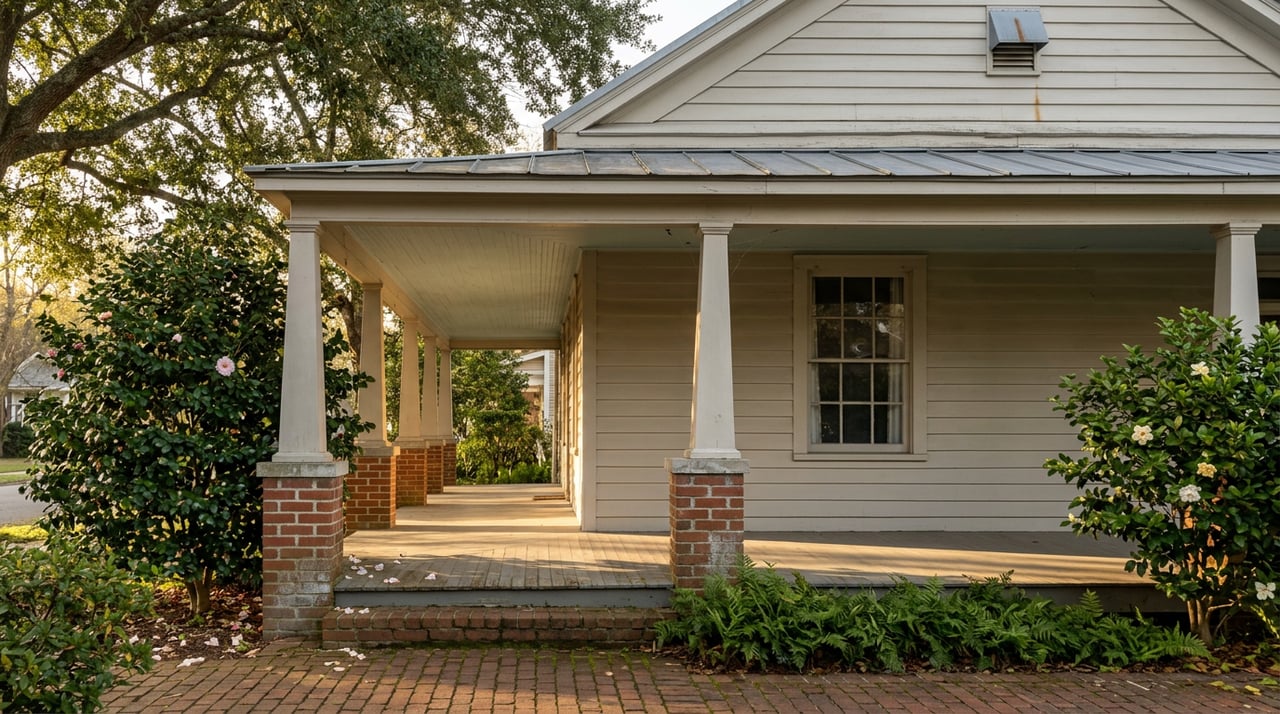
Which is the safer bet for an insurance underwriter: a bungalow built in 1919 that still has its original bones, or a bungalow built in 1919 with a metal roof installed a decade ago and an electrical panel swapped out in 2015? Ask a Southwest Florida carrier and the second house wins by a wide margin, and the reason has nothing to do with which one looks more historic from the street.
That distinction matters more in Fort Myers's Dean Park Historic District than almost anywhere else in Lee County, because Dean Park is one of the only pockets in this market where every home on the block is genuinely old. The district holds roughly seventy to eighty homes, most built between 1912 and the mid-1920s, a mix of Craftsman bungalows, Spanish and Mediterranean designs, English Tudor, and colonial revival, laid out along streets named Rhode Island, Providence, and Michigan by the developer who platted the subdivision, John Morgan Dean, in a filing recorded with the Lee County clerk's office on May 1, 1920. The neighborhood sits on the National Register of Historic Places, and its residents still run their own walking tour, revived after Hurricane Ian washed away the brochure kiosk that used to hold the maps.
None of that history shows up on the form an insurance carrier actually reads before writing a policy.
What a four-point inspection actually measures
A four-point inspection looks at exactly four systems: roof, electrical, plumbing, HVAC. It ignores everything else about a house, including its age on paper. As of 2026, most Florida carriers require one before writing or renewing coverage on a home twenty years or older, and Citizens Property Insurance Corporation will not issue a policy on a home over twenty years old without one passing. Several Southwest Florida carriers push that threshold even lower, sometimes requiring a report on homes as young as ten to fifteen years old, and industry guidance from earlier this year notes that a home forty years or older will almost certainly need one on file before a new carrier will write the policy at all.
By that math, every home in Dean Park needs one. What the inspection actually flags, though, depends entirely on what has been replaced and when, not on the year carved into the historic marker.
The roof clock resets with every reroof
According to LiveCovered, a 2022 Florida statute took roof age off the table as a stand-alone reason for an insurer to decline or drop a policy, provided the roof is younger than fifteen years and passes inspection. It is a real protection, and it was written for the state's median housing stock, not for a district where every house predates the interstate highway system. The law does not care that a house was built in 1921. It cares whether the roof currently covering it went up after roughly 2011.
That is where two Dean Park houses of the same vintage part ways. Insurers generally cap asphalt shingle roofs around fifteen to twenty years, tile in the range of twenty-five to forty, and standing-seam metal well beyond that, sometimes thirty to fifty years depending on the fastening system. A Craftsman bungalow with a metal roof installed within the last decade can sail through a four-point with a clean roof line item. A Spanish-style house two doors down with barrel tile that has been up since a 1990s reroof, or an original asphalt roof patched more than once, is the one that gets flagged, sometimes even when it is not leaking, because inspectors also document granule loss, cupping, and remaining service life, not just the calendar.
For a seller, the practical move is to know the install date of the roof currently on the house, not the year the house was platted, and to have that documentation ready before a buyer's carrier asks for it.
The panel is a brand problem, not an age problem
Electrical is where Dean Park's history actually works in a seller's favor, most of the time. A century-old house has almost always been rewired at least once, so the panel a four-point inspector finds is rarely the panel that shipped with the house. What carriers are screening for are two specific brands, Federal Pacific and Zinsco, along with aluminum branch wiring and any surviving knob-and-tube. None of those are about the house's founding year. They are about whichever decade the last rewire happened to land in.
A Dean Park seller's real electrical question is not how old the house is, but what panel is currently on the wall and when it was installed. A house that got a full panel swap in the 2000s is in a stronger position than a mid-century ranch across the river that never touched its original wiring.
Plumbing follows the same logic
The pattern repeats with plumbing. Inspectors are looking for pipe material, not house age. Copper and PVC pass without much comment, while older plastic supply lines with a known history of failure get flagged and can trigger a denial or a water-damage exclusion on the policy. Water heater age gets documented the same way. A home's founding year tells an inspector nothing about which of these materials is actually running behind the walls today. Only the renovation history does.
What this means before you list
Buyers in this price range are not just underwriting your house. They are underwriting whatever their lender requires their insurance carrier to approve, and that carrier will read your four systems as if the National Register plaque does not exist. A handful of Fort Myers inspection firms, including Coastal Home Inspectors, specialize in four-point reports for older Fort Myers homes and can turn most around the same day, which matters if you want to see the flags before a buyer's carrier does.
Before you sign a listing agreement, it is worth pulling together:
- The install date and material of the current roof, along with any manufacturer documentation of remaining service life
- A photo of the electrical panel with the brand name visible, plus the date of the last full panel replacement
- The pipe material currently supplying the house and the age of the water heater
- The age and working condition of the HVAC system
A four-point inspection ordered ahead of listing costs a fraction of what a failed one costs once a buyer is already under contract and their lender is waiting on an insurance binder. Ordering one before you list turns a possible closing-week surprise into a line item you already know about and can address before it ever reaches a buyer's underwriter.
A neighborhood that plans ahead already
Dean Park residents are used to this kind of coordination. The same community that revived its walking tour after Hurricane Ian, that still holds a January progressive dinner moving from house to house, and that works with city officials to keep its zoning and preservation rules intact, is well positioned to treat a pre-listing four-point inspection as one more piece of neighborhood stewardship rather than a hurdle to clear later. The houses were built to last a century. The paperwork just needs to catch up to what has actually been done to them since.
Common questions from Dean Park sellers
Does National Register listing affect my insurance underwriting? No. A four-point inspection evaluates roof, electrical, plumbing, and HVAC condition and age. Historic designation has no bearing on how a carrier rates those four systems.
If my roof was replaced ten years ago, does the 2022 Florida law protect me? Yes, on the roof specifically. A roof under fifteen years old that passes inspection cannot be denied for age alone under that law. The protection does not extend to the panel, plumbing, or HVAC, which are each evaluated on their own timelines.
Do I need a four-point inspection if I am not changing insurance carriers? Most renewals on homes over twenty years old will still require one at some point, since carriers use the same report to decide whether to keep insuring a property, not just whether to write a new policy.
Can a newer roof still fail a four-point inspection? Yes, if inspectors find active leaks, significant granule loss, or improper installation. Age is one factor among several, and even a roof under the age threshold can be flagged if its condition looks worse than its calendar age suggests.
If you own a home in Dean Park or anywhere in Fort Myers's older River District neighborhoods and you are thinking about listing, the conversation about insurance readiness is worth having before the sign goes in the yard, not after an offer comes in. Dr. Frank Dittschar works with sellers across Fort Myers's historic and established neighborhoods and can walk you through what a pre-listing four-point inspection is likely to show, system by system, before a buyer's carrier does it for you. Let's Connect.
This article is general information, not legal, tax or financial advice. Consult a qualified professional about your situation.